Flashy fish: electric eel powers Tennessee aquarium’s Christmas tree - The Guardian
Flashy fish: electric eel powers Tennessee aquarium’s Christmas tree - The Guardian |
| Flashy fish: electric eel powers Tennessee aquarium’s Christmas tree - The Guardian Posted: 04 Dec 2019 05:11 AM PST 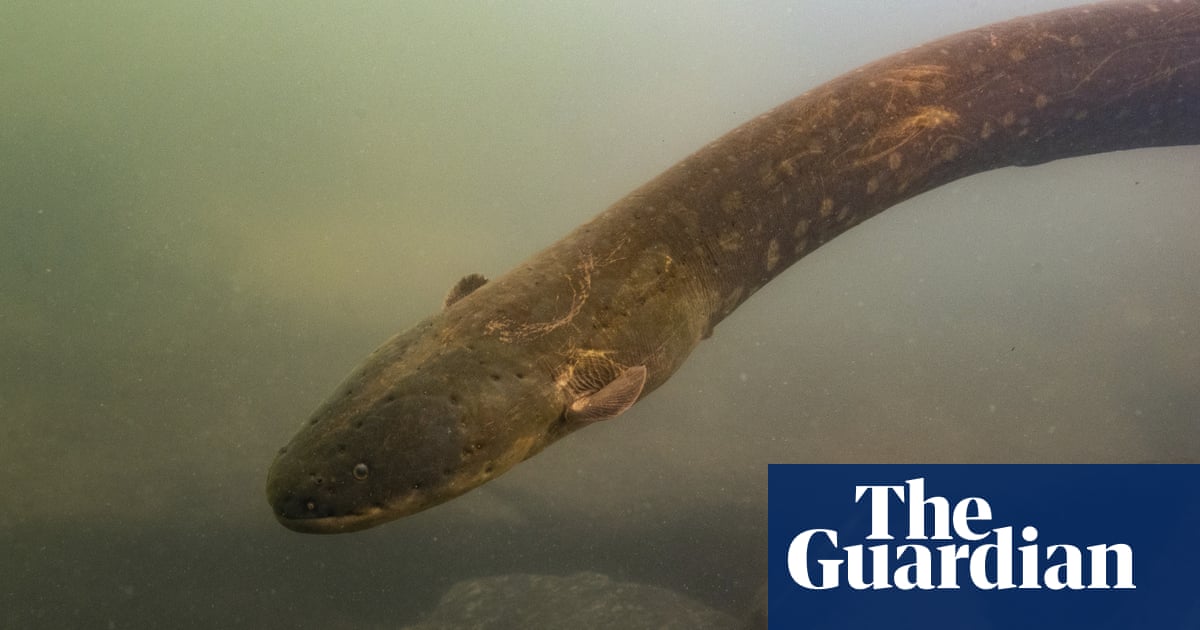 Visitors to the Tennessee aquarium may be shocked to learn that the Christmas tree is being powered by an unusual renewable energy source – an electric eel. The flashy fish goes by the name of Miguel Wattson and has his own Twitter account, @EelectricMiguel. A special system connected to Miguel's tank enables his naturally occurring shocks to power strands of lights on a nearby tree, the aquarium said in a news statement. Miguel releases low-voltage blips of electricity when he is trying to find food, aquarist Kimberly Hurt said.
That translates to a rapid, dim blinking of the Christmas lights. When he is eating or excited he emits higher voltage shocks which cause bigger flashes. Wattson's Twitter account allows him to share tweets generated by his sparky self, courtesy of coding by Tennessee Tech University's iCube center, an innovation unit for students and faculty. "They combined electrical engineering and emerging business communication to give the eel a voice," center director Kevin Liska said. In between Miguel's tweets boasting statements like "SHAZAM!!!!" and "ka-BLAMEROO!!!!!," a video posted to the account shows Miguel shaking in his tank as lights on the nearby tree sputter on and off.
The aquarium hopes the Christmas tree will be a powerful appreciation for the often feared electric eel and underappreciated eels of all kinds.
The lighting-up ceremony earlier this week – dubbed by some "shocking around the Christmas tree" – inspired a widespread glow of affection for Miguel and his extraordinary powers to illuminate can be seen in full effect from now until Christmas. |
| Posted: 05 Dec 2019 07:15 AM PST 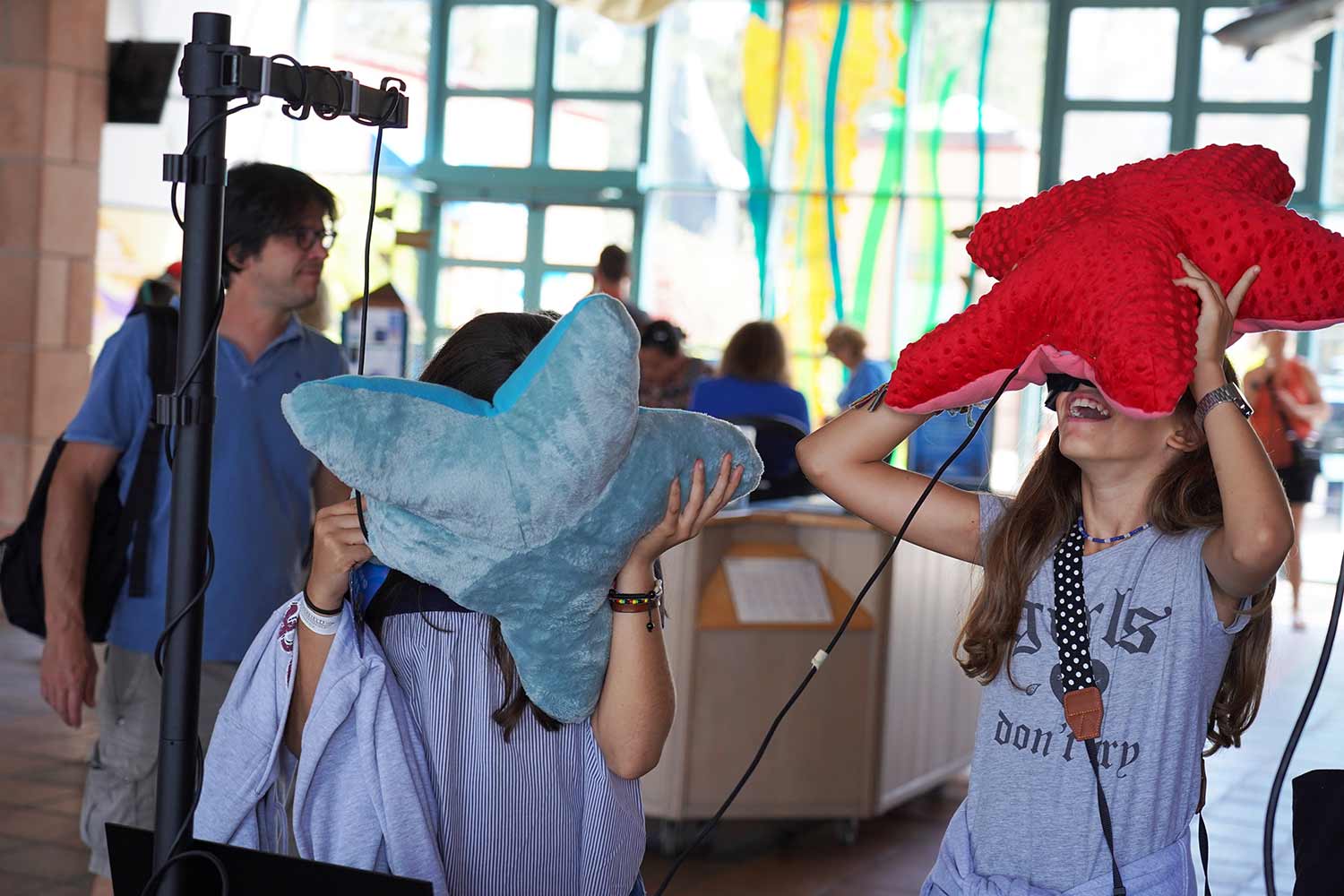 Visitors to Birch Aquarium test out different student-designed virtual reality mask prototypes. Summer EnVision Experience interns incorporated the feedback into their final VR exhibit design. Birch Aquarium at Scripps is breaking a barrier this spring. Instead of allowing visitors to just watch local marine life from behind glass, the aquarium is making it possible for visitors to experience life as fish do—thanks to a 360-degree virtual reality exhibit built by UC San Diego undergraduates. The new exhibit will be Birch Aquarium's first virtual reality experience and is made possible by campus-wide collaborations led by the Jacobs School of Engineering and its multidisciplinary Summer EnVision Experience program. 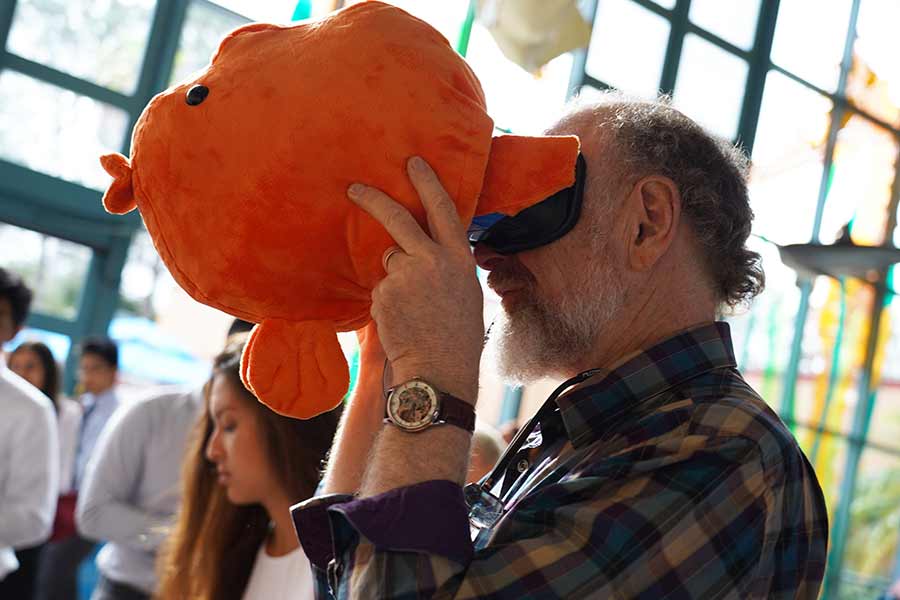 Harry Helling, executive director of Birch Aquarium at Scripps, takes a virtual dive into kelp forests off of Channel Islands National Park with the student-designed VR mask. Visitors to the aquarium will don a mask shaped like one of La Jolla's local marine animals—a bright orange Garibaldi fish, or a spotted Leopard Shark, for example. The mask is equipped with a VR headset, allowing visitors to tag along on a dive into kelp forests off of Channel Islands National Park. Future forays are planned into the San Diego-Scripps Coastal Marine Conservation Area, located just steps from the aquarium. This will allow aquarium visitors to experience life in one of California's verdant Marine Protected Areas (MPAs). "I am particularly excited for this because it breaks a barrier that we haven't been able to break prior, which is to introduce VR into our aquarium as a legitimate way to connect people to Scripps science," said Harry Helling, executive director of Birch Aquarium at Scripps. "And so we were excited to learn that the students took this on as a challenge, and to see that they've succeeded is a big deal for our aquarium, whose primary role is to translate complex science for general audiences." Ten undergraduate students spent 10 weeks over the summer crafting a way to incorporate virtual reality into the aquarium for the Summer EnVision Experience (SEE) program at the EnVision Arts and Engineering Maker Studio. The program, now in its third year of partnership with Birch Aquarium, is building on the Jacobs School of Engineering's commitment to collaboration. SEE brought together students from different disciplines across campus—engineering, cognitive science, interdisciplinary computing and the arts, for example—to collaborate with each other and the environmental researchers at Scripps Institution of Oceanography. Together, they were challenged to create an exhibit that would provide aquarium visitors with a deeper understanding of the need for Marine Protected Areas. The first question the multidisciplinary student team had to tackle was what physical form the VR exhibit should take. Should they build some sort of submarine that guests walk into? An interactive surfboard, in true San Diego fashion? Or perhaps a large wall with interactive video? 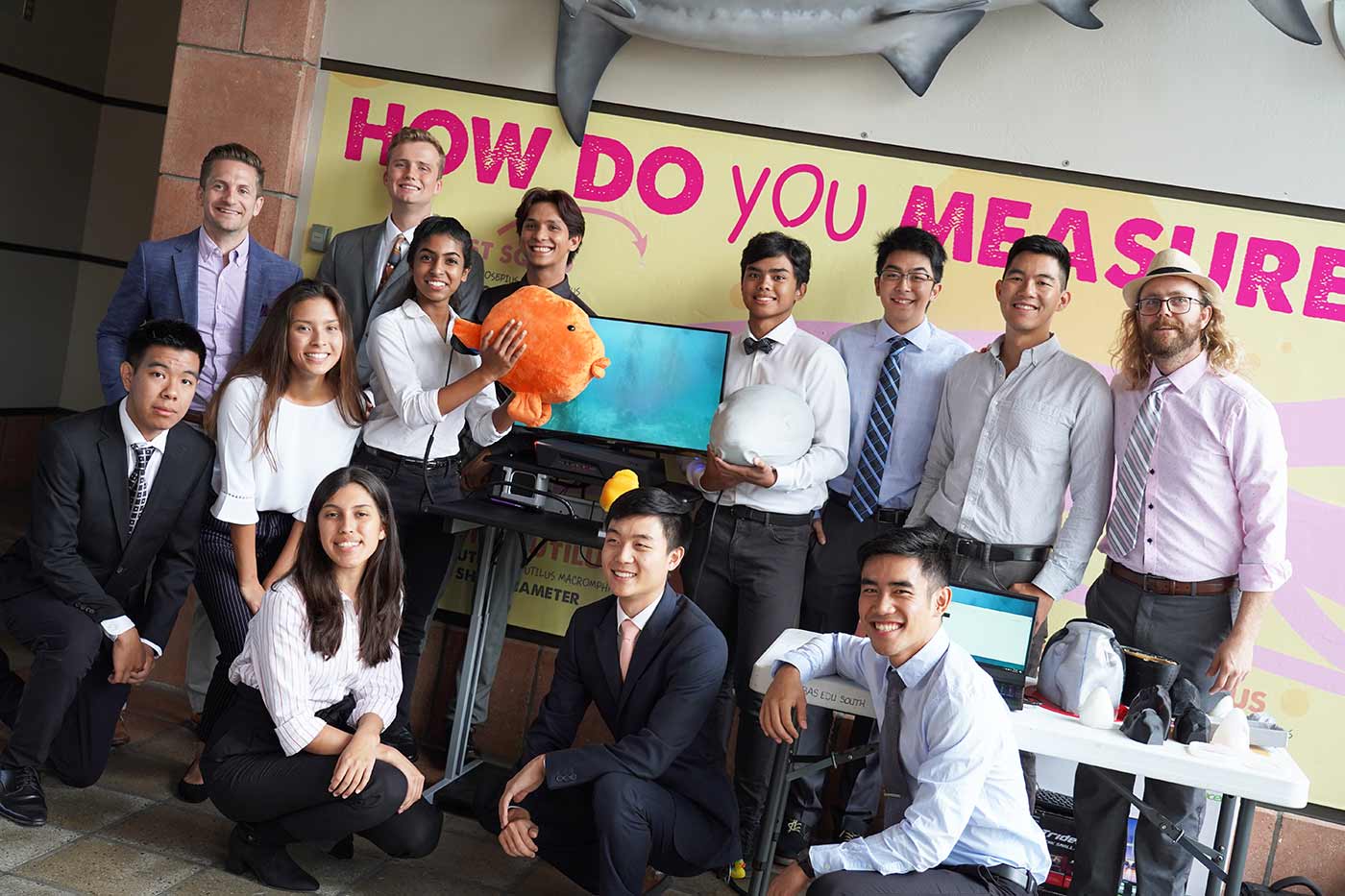 The Summer EnVision Experience team displays the final cloth and silicon versions of the VR mask at a closing presentation at Birch Aquarium. After designing prototypes and working with Birch Aquarium exhibit staff, the students decided that creating a VR fish mask would be the best option to immerse visitors in the Marine Protected Area while also fitting in with existing aquarium space constraints. The next question was what type of VR setup would work best—the mask hanging from a wire that users can move with? A more stationary desk-based stand? "In the beginning, we were trying to figure out how people would interact with it," said Sicily Panattil, a bioengineering student and EnVision intern. "Would they want to move it around? Is their initial gut instinct to take it and walk away, or is their initial gut instinct to stay and look around? Those are a couple of the research ideas we had to work through." After testing several prototypes at the aquarium, students decided that having a stationary desk mount for the VR headset with a computer screen playing the same footage the visitor was experiencing for other onlookers to see was the best solution. Students created both cloth and silicon versions of the mask, along with detailed manufacturing instructions for easy replication. Karen Rosales, an aerospace engineering student, designed more than 15 different sewing patterns for the polyester plush fabric mask, with the zipper, VR headset and wire in various different locations, before settling on a final design. The silicon version consists of a ¼-inch-thick silicone skin covering a polyurethane foam interior. The team created 3D computer aided design models, and developed a molding process that could be easily replicated by aquarium staff. 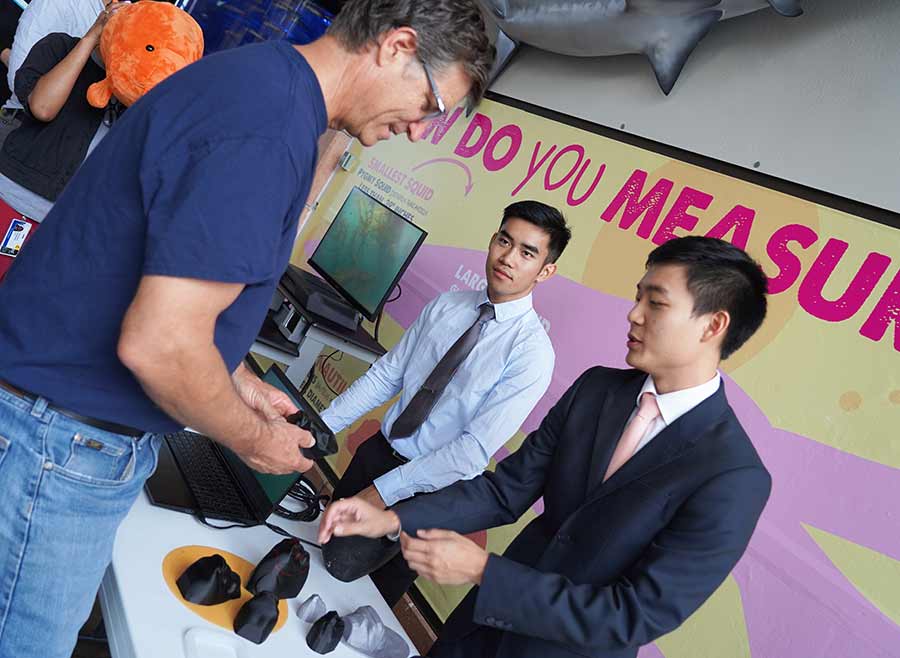 Summer EnVision Experience interns explain the fabrication process for their silicon mask. The final component—the 360-degree video footage itself—comes courtesy of independent filmmaker Erik Rochner of Rochner Films. By helping visitors feel a deeper sense of connection with California's Marine Protected Areas, Birch Aquarium staff hopes the VR exhibit will inspire visitors to become advocates for the MPAs. Student participants said they enjoyed not only getting to learn about the world of museum exhibits and the process of creating something for a wide range of people to use and enjoy, but also appreciated getting hands-on experience with new tools they hadn't all used before. "It was really interesting to learn how to use the EnVision studio maker space because I had very limited experience using it before," said Will Stock, an interdisciplinary computing and the arts student. "It was really nice to be able to get a lot of experience using laser cutters, 3D printers, and sewing machines." This is the third year of the Summer EnVision Experience internship program, thanks to philanthropic support from the Charles Lee Powell Foundation, which provided funding for the program. "I'm predicting that this is going to be very popular and that this is the start of an exciting journey for all of us here at the aquarium and also for future SEE classes," Helling said. |
| You are subscribed to email updates from "big fish aquarium" - Google News. To stop receiving these emails, you may unsubscribe now. | Email delivery powered by Google |
| Google, 1600 Amphitheatre Parkway, Mountain View, CA 94043, United States | |

Comments
Post a Comment