Does Fish Skin Have a Future in Fashion? - Smithsonian Magazine
Does Fish Skin Have a Future in Fashion? - Smithsonian Magazine |
| Does Fish Skin Have a Future in Fashion? - Smithsonian Magazine Posted: 11 Jun 2021 08:22 AM PDT Elisa Palomino-Perez sheepishly admits to believing she was a mermaid as a child. Growing up in Cuenca, Spain in the 1970s and '80s, she practiced synchronized swimming and was deeply fascinated with fish. Now, the designer's love for shiny fish scales and majestic oceans has evolved into an empowering mission, to challenge today's fashion industry to be more sustainable, by using fish skin as a material. Luxury fashion is no stranger to the artist, who has worked with designers like Christian Dior, John Galliano and Moschino in her 30-year career. For five seasons in the early 2000s, Palomino-Perez had her own fashion brand, inspired by Asian culture and full of color and embroidery. It was while heading a studio for Galliano in 2002 that she first encountered fish leather: a material made when the skin of tuna, cod, carp, catfish, salmon, sturgeon, tilapia or pirarucu gets stretched, dried and tanned. "[Fish skin] was such an incredible material. It was kind of obscure and not many people knew about it, and it had an amazing texture. It looked very much like an exotic leather, but it's a food waste," Palomino-Perez says. "I've got a bag from 2002 that, with time, has aged with a beautiful patina."  The history of using fish leather in fashion is a bit murky. The material does not preserve well in the archeological record, and it's been often overlooked as a "poor person's" material due to the abundance of fish as a resource. But Indigenous groups living on coasts and rivers from Alaska to Scandinavia to Asia have used fish leather for centuries. Icelandic fishing traditions can even be traced back to the ninth century. While assimilation policies, like banning native fishing rights, forced Indigenous groups to change their lifestyle, the use of fish skin is seeing a resurgence. Its rise in popularity in the world of sustainable fashion has led to an overdue reclamation of tradition for Indigenous peoples. In 2017, Palomino-Perez embarked on a PhD in Indigenous Arctic fish skin heritage at London College of Fashion, which is a part of the University of the Arts in London (UAL), where she received her Masters of Arts in 1992. She now teaches at Central Saint Martins at UAL, while researching different ways of crafting with fish skin and working with Indigenous communities to carry on the honored tradition. "For the past four years, I have been traveling all around the world, connecting all these incredible elders, all these Indigenous people—the Ainu on Hokkaido Island in Japan, the Inuit, Alutiiq and Athabaskan in Alaska, the Hurst in Northeast China, Sami in Sweden and Icelanders—and studying different technology of fish skin," she says.  Traditionally, the Ainu people in Japan used salmon skin for boots, similar to the Inuit, Alutiiq and Athabaskan in Alaska, who also used the skin for mittens, parkas and clothing. While this practice was once essential to survival, it also held spiritual significance with the afterlife and water deities in communities that believe that people must cross a river from this world to the next after death. But the fish skin tradition eventually declined in the 20th century, due to colonialism, assimilation and changing policies and laws affecting Indigenous groups. Most recently, Palomino-Perez took part in an anthropology fellowship, and is now a research associate, at the National Museum of Natural History's Arctic Studies Center in Washington D.C. Beginning in December 2020, the designer studied—virtually from her home in Italy, due to the Covid-19 pandemic—fish leather baskets, boots and mittens in the Smithsonian's collection, from communities like the Inuit people of Greenland, Yup'ik people of Kuskokwim River in Southwest Alaska and the Alutiiq on Kodiak Island. These artifacts and her conversations with Indigenous elders in Alaska inspired her to create fish skin bags and sneakers. One of her clutches, for example, has plant-like designs digitally printed in water-based inks of soft pinks, oranges and tans onto fish leather. Palomino-Perez is now trying to put together a fish skin coalition with artists from Alaska, Japan, Greenland and more to collaborate and explore fish skin fashion and technology.  "Here's something from the past, it pretty much had been forgotten, and yet, it's now being revived and has tremendous socially and environmentally laudable goals," says Steven Loring, museum anthropologist and an Arctic archaeologist working in the Smithsonian's Arctic Studies Center. According to Hakai Magazine, humans worldwide consumed a little under 150 million tons of filleted fish in 2015. One ton of filleted fish amounts to 40 kilograms of fish skin, and so in that year alone, the industry produced about six million tons of skins that could have been recycled. Obtaining the material isn't as complicated as it might seem. Current commercial fish leather comes from sustainable farms operating in the same areas as tanners, who remove any excess meat off the fish skin and use tree bark, like Mimosa bark, to stretch, tan and dry the skin, as has been done in traditional processes. Agricultural farms that make fish fillets to be frozen supply tanners with their fish skin by-product.  While brands like Prada, Christian Dior, Louis Vuitton and Puma have used fish leather for clothes and accessories before, younger designers and startups are now showing interest—and Palomino-Perez is eager to normalize the practice. Sourcing her fish skin from Iceland, she designs, dyes and assembles her fashion accessories. She also works with a traditional indigo dyeing master in Japan, who grows the flowering plant, to dye her fish skin with stencils. A golden salmon skin clutch of hers is brilliantly contrasted with indigo floral-like patterns.  Palomino-Perez's work will be featured at Smithsonian's "FUTURES," an interdisciplinary show opening at the Arts and Industries Building in Washington, D.C. in November and running through summer 2022. Part exhibition, part festival, "FUTURES" will highlight nearly 150 objects dedicated to different visions of the future of humanity. "We ideated values that we think are going to be important to building a hopeful, sustainable and equitable future, and organized our content around those values," says Ashley Molese, a curator for "FUTURES."  The exhibit embraces a "choose your own adventure" model, according to Molese, which encourages visitors to explore the displays in any order. In the building's West Hall, one of Palomino-Perez's fish skin clutches will be on display next to a fish skin pouch handcrafted by the Unangan Aleut peoples of Western Alaska acquired by the National Museum of Natural History in 1921, as a way of connecting traditional objects and contemporary work from the same crafting process. This section of "FUTURES" focuses on the value of slowness, and innovation that isn't technological and digital. Fish skin fashion is a testament to how the future of sustainability may find its salvation in time-honored traditions.  "These are living cultures, these aren't things of the past," says Molese. "When we talk about Indigenous traditions, Indigenous practices, Indigenous cultures; they're still living and breathing." Molese adds: "We really wanted to have the visitor find something that is a unique moment for them in the show that helps build a sense of hope and agency that they could then embody, and then maybe even take action once they leave our doors."  When it comes to using animal skins in fashion, fish skin proves to be one of the better options for the environment. At the end of the day, fish skin is food waste; it gets thrown back into the ocean or tossed away when companies process fish. From 1961 to 2016, the global per capita consumption of fish has grown from nine kilograms to a little over 20 kilograms a year, resulting in loads more discarded skin that could have a second life. While it's pricier, and takes longer to process (about a week or so) compared to cow leather (a few days), fish skin is more durable, breathable and water-resistant. Working with fish skin ensures respect toward fish stocks and marine ecosystems and diverts attention away from endangered species used for fashion. To do her part, Palomino-Perez has been working to ensure that fish skin crafting becomes even more sustainable. She is working on a tanning technique from China, that uses cornflower to soak in and remove the fish skins' oils to create leather—a marked improvement from other tanning methods that can release harmful chemicals that pollute the air. With the University of Borås in Sweden, she will be developing ways to 3-D print with filaments made from tuna waste, instead of plastic. Additionally, Palomino-Perez has been organizing Zoom workshops led by Indigenous elders and museum curators to train and teach individuals, like tanning artists, fashion students and other Indigenous people, the fish-crafting process. Eventually, she hopes fish skin will replace exotic skins in fashion. Producing natural and detailed items in a respectful way and without chemicals or harm toward the environment is the future, according to Palomino-Perez. "There's no other way to be working right now," she says.  Palomino-Perez envisions fish skin material as both an empowering and natural concept in the future of fashion. She's past the idea of "overpowering nature" and disrespecting animals, and is adopting a respect toward the planet and ourselves that Indigenous peoples have long embraced. "There's many people who are interested in the material," she says, "so slowly, it's picking up." |
| Arthur Treacher's Fish and Chips is Alive and Well in Cleveland - Cleveland Scene Posted: 10 Jun 2021 01:30 PM PDT click to enlarge 
Few dining experiences manage to live up to indelible memories of meals shared with family. But one bite into the corn-scented hush puppies at Arthur Treacher's Fish and Chips in Garfield Heights and I was instantly transported back in time to the restaurant on Mayfield Road. In the mid-1970s, that store, with its iconic yellow and green lantern sign, was the unanimous fast-food favorite among me and my brothers. The seafood-focused menu felt a bit more upscale than the run-of-the-mill burger barn and dousing everything with malt vinegar seemed pleasantly foreign and exotic. Despite practically vanishing from the face of the earth, Arthur Treacher's Fish & Chips has been making the rounds on the news circuit recently. That's because parent company Nathan's Famous recently announced plans to expand the historic brand's presence by offering ghost kitchen franchises. "Nathan's Famous and Arthur Treacher's have a long standing relationship and we have worked diligently to keep the brand's traditional menu items while also evolving the menu to fit the Nathan's mantra of 'Craveable, Memorable and Instagrammable' product that we believe both operators and customers will love," states Nathan's Senior VP James Walker. That relationship between Nathan's Famous and Arthur Treacher's came about when Nathan's, a former franchisee of Arthur Treacher's, decided to buy the parent company outright. Nathan's, which started selling hot dogs in 1916, has expanded exponentially in recent years, with locations scattered around the globe. At some stores they offer a limited line of Arthur Treacher's dishes. Things start getting more confusing when one attempts to link Nathan's version of Arthur Treacher's with the last two brick-and-mortar restaurants of the same name, both of which are located in Northeast Ohio. Those restaurants are owned by Ben Vittoria, who has been involved with Arthur Treacher's since the mid-1970s. "We have a unique situation," Vittoria explains. "Arthur Treacher's has been sold a number of times, and one of the companies retained the rights to Ohio and Virginia. So we have really no relationship with Nathan's." Few people alive are more knowledgeable about the iconic brand's rise and fall than Vittoria. After joining the parent company at the corporate level in the 1970s, he switched to the ownership side, purchasing the Cuyahoga Falls location in 1988 and the Garfield Heights shop in 2001. In 2005, he relocated the Cuyahoga Falls store from its original 1972 building to a former Wendy's with a drive-through window. Arthur Treacher's started in Columbus in 1969, eventually growing to a national chain of more than 825 locations. By most accounts, the two Ohio stores are the very last standalone restaurants offering the original menu starring hand-battered fish and chips. "Most of the old franchisees have reached an age where they have retired or passed away," he says. "Others have decided to change to something else." Because Vittoria worked for years at the corporate level, he's familiar with the original recipes, seasonings and specifications, all of which he adheres to out of loyalty and continuity. "There are a lot of dissimilarities between what Nathan's uses today and what we use, because we continue to use the traditional Arthur Treacher's chicken, shrimp and clams and I don't believe Nathan's is using any of those products," he explains. Both use the same batter and hush puppy mix, he adds, but Nathan's uses crinkle-cut fries instead of the original thicker ridged "chips." I had always known that there was an Arthur Treacher's restaurant 30 minutes from my house, but I never felt compelled to visit. It was only when I realized how few of them actually existed that I made note of going sooner rather later. The pandemic arrived and I worried that I might have missed my window. But survive they did. "Like many restaurants we had to endure a period of uncertainty," Vittoria says. "Not only did we have to deal with the pandemic, we had to deal with the rules and regulations from the CDC. But we adapted. It was easier at Cuyahoga Falls because of the drive-through. But in the last couple of months, we've seen a resurgence of people dining in." click to enlarge A couple weeks back I went to an Arthur Treacher's for the first time in 40 years and ordered pretty much everything on the menu. I dunked the crispy pie-shaped fish fillets in tartar sauce. I dragged the squiggly fried clams through cocktail sauce. I doused those fat fries with too much malt vinegar. And I inhaled the heavenly hush puppies. I snapped pictures of my food and immediately texted them to my brothers so we could share the experience. Their synapses, too, dredged up decades-old memories of clam strips and hush puppies and paper boats.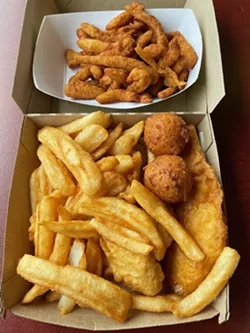
Nostalgia is a powerful emotion, but is it enough to keep a business afloat? "Arthur Treacher's has a strong brand recognition and it always did," says Vittoria. "This is a concept that started in 1969 and grew to 800-plus restaurants in the mid-70s. People brought their children and now they bring their grandchildren. And now I see millennials who come in and say I used to come here with my grandpa, or my mom used to bring this food home and we loved it." Barely a day goes by, adds Vittoria, that he doesn't field a call from some wistful food tourist who heard that Arthur Treacher's is alive and well in Cleveland, Ohio, and would he be open on such and such a date when he'll be in town from Florida or Arizona or New Paltz. Vittoria still loves the work, but he was not willing to place bets on its long-term survival. "From a business point of view, I wouldn't be working unless I believed it was worthwhile," he says. "But I'm at the twilight of my experience with Treacher's. Almost 50 years with the company and I have nothing but good memories." |
| You are subscribed to email updates from "exotic fish" - Google News. To stop receiving these emails, you may unsubscribe now. | Email delivery powered by Google |
| Google, 1600 Amphitheatre Parkway, Mountain View, CA 94043, United States | |

Comments
Post a Comment